Why AOMT exists
The downstream effect of oral dysfunction
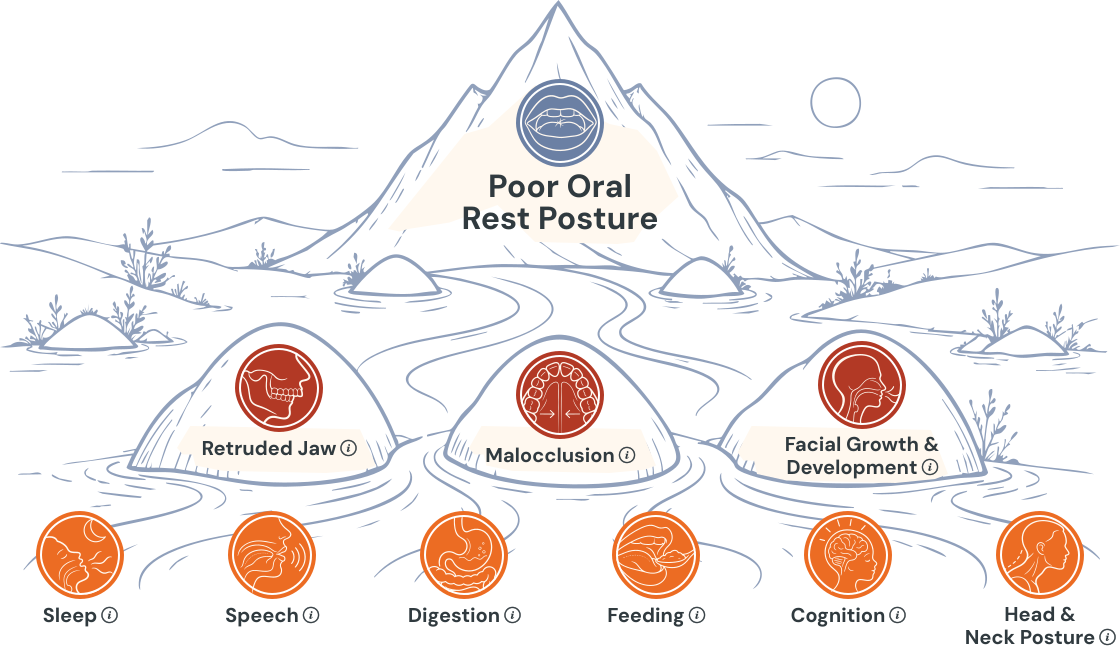
The mouth sits at the intersection of multiple systems, and multiple professions. Yet the relationships between oral function, craniofacial growth, the upper airway, sleep, and whole-body function have historically been divided across separate disciplines and curricula.
For decades, clinicians have been connecting these pieces through the problems they encounter in everyday practice. AOMT exists to bring those connections together. To fill the gaps between disciplines and teach the shared science of function, including how dysfunction in one part of the body can have a downstream physiologic impact.
Primary effects
 Retruded Jaw
A lower jaw (mandible) that sits farther back can affect tongue position and the space available for breathing. Poor oral rest posture and altered muscle function can also influence jaw development during childhood, creating a relationship between facial structure, breathing, and oral function.
 Malocclusion
The tongue, lips, and cheeks help guide tooth position and dental arch development through gentle, continuous pressure. When the tongue rests low or the lips remain apart, these forces can become imbalanced, contributing to crowded teeth, narrow dental arches, and bite problems.
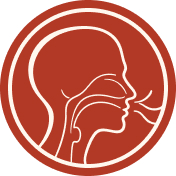 Facial Growth & Development
The way we breathe and position our tongue influences how the face and jaws develop, especially during childhood. Persistent mouth breathing and poor tongue posture can contribute to changes in palatal width, dental arch development, and facial growth patterns.
Downstream effects
 Sleep
Tongue position, jaw structure, and breathing patterns can influence airway stability during sleep. Oral dysfunction may coexist with sleep-disordered breathing, contributing to disrupted sleep, daytime fatigue, and difficulties with attention and behavior.
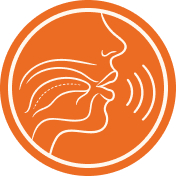 Speech
Clear speech requires coordinated movement of the tongue, lips, and jaw. Poor tongue posture and altered oral muscle function can contribute to certain speech sound distortions, including lisps and difficulty producing sounds such as /s/, /z/, and /r/.
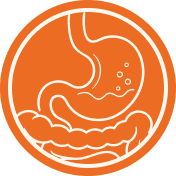 Digestion
 begins in the mouth, where chewing and saliva break down food and prepare it for swallowing. Poor tongue function and inefficient chewing can interfere with this first stage of digestion, affecting how effectively food is prepared for the digestive system.
 Feeding
Eating requires coordinated movements of the tongue, lips, jaw, and swallowing muscles. Oral dysfunction can make it difficult to chew effectively, manage different food textures, and move food safely through the mouth, contributing to feeding challenges and prolonged mealtimes.
 Cognition
Healthy breathing and restorative sleep support memory, attention, learning, and emotional regulation. When oral dysfunction is associated with airway restrictions or disrupted sleep, it can indirectly affect cognitive function, particularly in developing children.
 Head & Neck Posture
Breathing, tongue position, and jaw function are closely connected to head and neck posture. Individuals with airway restrictions or habitual mouth breathing may adopt a forward head position to help facilitate breathing, contributing to altered muscle activity and postural strain.
The research behind the field
Myofunctional Sciences
Myofunctional sciences sit at the intersection of breathing, sleep, oral function, craniofacial development, and the stomatognathic system. Researchers have studied the relationships between function, growth, airway health, mastication, sleep, and neuromuscular patterns for decades. Today, a growing body of research is helping clinicians better understand both why oral function matters and where myofunctional therapy plays a therapeutic role.

Sleep medicine has produced some of the strongest direct research evaluating myofunctional therapy. Systematic reviews and meta-analyses have examined changes in apnea-hypopnea index (AHI), oxygen saturation, daytime sleepiness, sleep quality, and snoring following myofunctional therapy. The evidence continues to evolve.
-
Myofunctional Therapy to Treat Obstructive Sleep Apnea: A Systematic Review and Meta-analysis
This landmark meta-analysis found improvements in AHI, lowest oxygen saturation, snoring, and daytime sleepiness following myofunctional therapy.
Camacho et al., 2015 -
Myofunctional Therapy (Oropharyngeal Exercises) for Obstructive Sleep Apnoea
A review of randomized controlled trials found evidence that myofunctional therapy may improve several sleep-related outcomes in adults.
Rueda et al., 2020 — Cochrane Review -
Myofunctional Therapy for OSA: A Meta-analysis
Across 15 studies, the authors reported improvements in AHI, lowest oxygen saturation, and daytime sleepiness following myofunctional therapy.
Meghpara et al., 2022 -
Myofunctional Therapy in Adults and Children With Obstructive Sleep Apnea: An Overview and Re-Analysis of Systematic Reviews
This re-analysis of nine systematic reviews found improvements in adult OSA severity, daytime sleepiness, sleep quality, and minimum oxygen saturation.
Pisoni et al., 2026
Oral function is closely integrated with the muscles and movement patterns of the stomatognathic system. Research from Cláudia Maria de Felício and colleagues in Brazil has directly examined orofacial myofunctional therapy in patients with temporomandibular disorders.
-
Effects of Orofacial Myofunctional Therapy on Temporomandibular Disorders
In this randomized study, patients receiving orofacial myofunctional therapy demonstrated improvements in pain, mandibular range of motion, signs and symptoms of TMD, and measures of orofacial myofunctional function.
de Felício et al., 2010
One of the reasons healthy breathing and sleep matter is the developing brain’s response to disrupted sleep and intermittent hypoxia. The work of David Gozal and colleagues has helped define relationships among pediatric obstructive sleep apnea, intermittent hypoxia, oxidative stress, inflammation, and neurocognitive function.
-
Impaired Spatial Learning and Hyperactivity in Developing Rats Exposed to Intermittent Hypoxia
This experimental work demonstrated developmental vulnerability to intermittent hypoxia and helped establish an important mechanistic foundation for later pediatric sleep research.
Row et al., 2002 — David Gozal, co-author -
Neurocognitive and Behavioral Morbidity in Children With Sleep Disorders
This review examined accumulating evidence linking sleep fragmentation and intermittent hypoxia with changes in memory, attention, intelligence, and behavior.
Gozal & Kheirandish-Gozal, 2007 -
Cognitive Function in Prepubertal Children With Obstructive Sleep Apnea
This work explored oxidative stress pathways and individual susceptibility to neurocognitive effects in children with OSA.
Gozal et al., 2012
Chewing is more than food preparation. Mechanical loading created through mastication influences the tissues of the craniofacial complex. The work of Takashi Ono and colleagues has explored how changes in masticatory forces influence mandibular bone, condylar development, muscle function, and craniofacial biology.
-
Forceful Mastication Activates Osteocytes and Builds a Stout Jawbone
Experimental research demonstrated that masticatory loading activates bone mechanotransduction and influences mandibular bone formation.
Inoue et al., 2019 — Takashi Ono, co-author
Breathing and sleep during early childhood occur during periods of extraordinary neurological development. Large longitudinal studies have examined associations between childhood sleep-disordered breathing—including snoring, witnessed apnea, and mouth breathing—and later behavioral, learning, and educational outcomes.
-
Sleep-Disordered Breathing in a Population-Based Cohort: Behavioral Outcomes at 4 and 7 Years
Using data from the Avon Longitudinal Study of Parents and Children, researchers followed sleep-disordered breathing symptoms from infancy through childhood and identified associations with later behavioral outcomes.
Bonuck et al., 2012 — Avon Longitudinal Study -
Pediatric Sleep Disorders and Special Educational Need at 8 Years
The same population-based cohort was used to investigate associations between early sleep-disordered breathing and later special educational needs.
Bonuck et al., 2012

Learn how to follow the function.
Breathing, sleep, chewing, swallowing, oral rest posture, craniofacial growth, and neuromuscular function do not exist in isolation. Myofunctional sciences bring these areas of research together.
Understanding these relationships helps clinicians recognize dysfunction earlier, evaluate it more comprehensively, and collaborate across disciplines when treatment is indicated.